
Showing up is an anti-poverty program
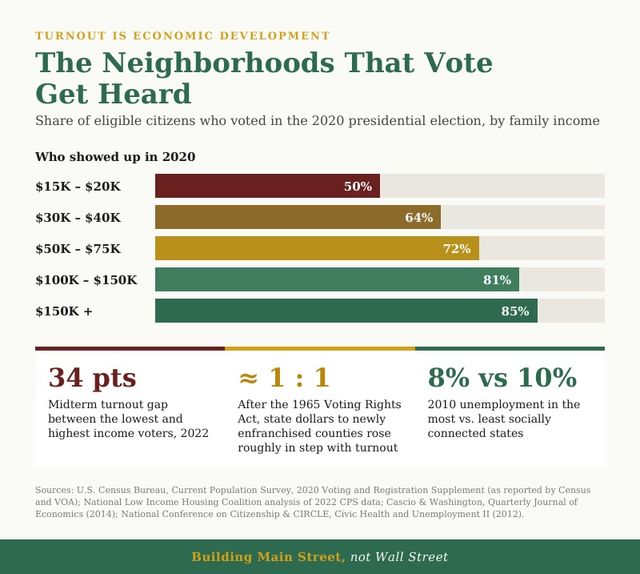
When Dallas last chose a mayor, roughly six of every hundred eligible residents cast a ballot. Across the 30 largest cities in America, the average was only about one in five. Let that settle in for a moment. A small handful of people decided who would steer the budget, the streets, the zoning board and the economic development office for everyone else.
I have spent a lot of years watching how decisions get made in small towns and county seats, and I have come to believe something that sounds simple but is not said nearly enough. Turnout is not just a civic statistic. It is an economic one. The neighborhoods that vote get heard. The neighborhoods that do not vote get managed.
The gap starts with who shows up. In the 2020 presidential election, about 85 percent of people in households earning more than $150,000 voted, compared with roughly half of those in households earning between $15,000 and $20,000. In midterms the gap grows. In 2018, about two thirds of eligible voters making over $100,000 cast ballots, while fewer than one in three of those making under $20,000 did.
Here is why that matters on Main Street. For three decades, researchers have compared states where working families vote at high rates with states where they mostly stay home. States with a bigger class gap in turnout tend to spend less on the safety net. In states where lower income turnout came closer to matching that of the well off, lawmakers were much less likely to adopt tougher welfare rules after the 1996 reforms. Other studies find that states with wider turnout gaps also tend to have wider income gaps.
I want to be fair about what this proves. Economists will tell you about the link between income and voting is well documented but not fully understood, and a correlation is not a cause. Plenty of other forces shape poverty, from local wages and housing costs to whether the plant down the road stays open. But when the same pattern keeps turning up across states and decades, it deserves attention.
The strongest evidence comes from our own history. When the Voting Rights Act of 1965 knocked down literacy tests, Black turnout climbed in the affected Southern counties. Economists at Dartmouth and Yale later found that those same counties saw their share of state money grow, mostly for public schools, compared with similar counties that had no such tests. By their estimate, state dollars rose roughly in step with turnout. New voters brought new investment. That is not ideology. That is how politics works.
And this is not about which party wins. Office holders of every stripe pay closest attention to the people most likely to show up and reelect them. If the folks on the east side of town, the mobile home park off the highway or the young families renting above the downtown shops never vote, their roads, their schools and their business districts slide toward the bottom of the list. Nobody has to be cruel for that to happen. It is pretty simple arithmetic.
There is a Main Street dividend as well. A study covering more than 3,100 counties found that communities with stronger civic health weathered the Great Recession with smaller jumps in unemployment, even after accounting for economic conditions. By 2010, the most socially connected states had unemployment near 8 percent, while the least connected sat near 10 percent. Engaged places hold on to their jobs, their storefronts and each other.
Researchers who mapped local turnout found what they called voting deserts, neighborhoods where participation runs at less than half the citywide rate. I would bet you can name yours. I suspect those are many of the same streets where the empty storefronts cluster and family budgets are stretched the thinnest. We will not grant or subsidize our way out of that alone. People in those neighborhoods need a seat at the table, and the ballot is the cheapest seat in the house.
Election Day is Tuesday, November 3. Within the next 24 hours, visit Vote.gov, confirm your registration and find where you vote. Then do one more thing. Invite one neighbor, coworker or employee who usually sits elections out to go with you and offer the ride. If you own a business, give your people the time. After the election, pick one city council, county commission or school board meeting this winter and attend it. Poverty is not beaten in a single election, but it is never beaten by the people who stay home.
John A. Newby, a Chamber CEO, Publisher & Media Executive, Business Owner, Consultant & International Speaker is the author of the "Building Main Street, Not Wall Street" a column dedicated to helping local businesses & communities build stronger foundations allowing them to thrive in a world where local is lost to Wall Street interests. His email is john@truly-local.org
McDonald County Chamber of Commerce
308 Harmon Street
Pineville, MO 64856
417-223-8888
www.mcdonaldcountychamber.org