Community Information Shouldn't Be Trapped on Facebook
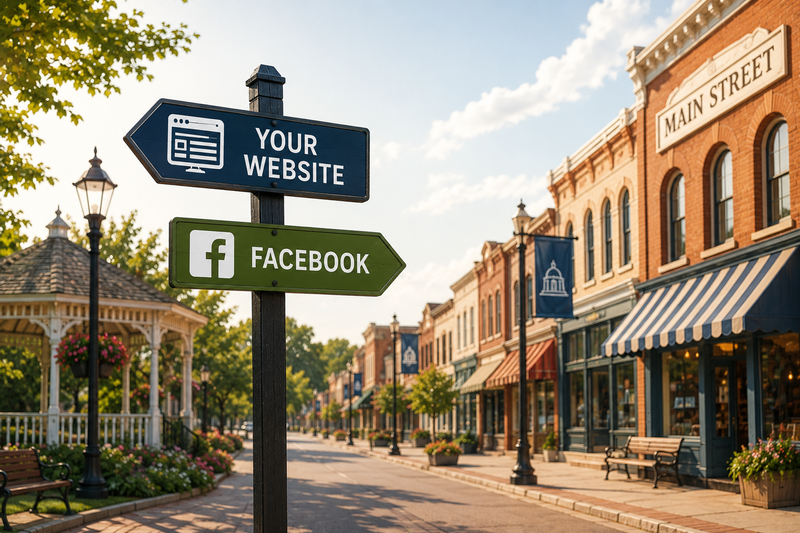
For a restaurant, Facebook-only communication is usually a marketing mistake. For cities, Main Streets, libraries, schools, tourism organizations, chambers, and other community anchors, it's something bigger.
When important information only exists on Facebook, you're limiting who can find it, who can access it, and who can participate. In some cases, you're also creating unnecessary accessibility, records retention, and public information risks.
The issue isn't Facebook itself. The issue is treating Facebook as the place where public information lives instead of using it as one channel to distribute information.
The Problem Is Facebook-Only Communication
Using Facebook is not the issue. Depending on Facebook is the issue.
Facebook is useful as a spoke. It is a good place to share quick updates, promote events, and remind people what is happening locally. But it should not be the primary home for public-facing information like event schedules, vendor applications, maps, meeting updates, registration links, volunteer opportunities, or local announcements.
Not everyone uses Facebook. Not everyone follows your page. Not everyone sees your posts, even if they do follow your page.
Facebook’s algorithm decides what shows up, when it shows up, and who sees it.
Facebook is also a privately controlled platform. Your organization does not control its algorithm, search experience, access rules, layout changes, or long-term availability.
Your website is different. It is the place you control. It is the place Google can more reliably index. It is the place people can return to when they need accurate information.
For cities, schools, libraries, Main Streets, Chambers, tourism organizations, and other local anchors, this matters because your job is not just to post information. Your job is to make information findable and usable.
Important: If you're a city, county, school, library, Main Street program, tourism organization, chamber, or other public-serving entity, review applicable federal, state, and local requirements regarding accessibility, records retention, public information, and open meetings. Relying on Facebook or other third-party platforms as the sole source of public information may create unnecessary compliance and public access risks.
People Search Google, Not Your Facebook Timeline
When residents, visitors, vendors, volunteers, parents, or business owners need information, many of them start with Google.
If your event details, applications, schedules, maps, or public updates only exist on Facebook, they may not show up clearly in search results. Even when they do appear, the experience is often messy, incomplete, or gated behind a platform people may not use.
The result is predictable:
- People miss events they would have attended
- Vendors miss applications they would have submitted
- Residents ask the same questions over and over
- Staff wastes time reposting, replying, and hunting for old links
- Community participation suffers
If people cannot find the information, they cannot act on it.
Your Website Should Be the Hub
The better approach is simple: your website should be the source of truth.
This is the “hub and spoke” model. Your website is the hub where official, accessible, searchable information lives. Facebook, Instagram, email newsletters, partner websites, local media, and other channels are the spokes that help distribute and promote that information.
This aligns with the Marketing 3-4-5™ approach to distribution: publish useful content once, then distribute it through multiple channels so it reaches more people in more places.
For public-serving organizations, the hub should include things like:
- Event schedules
- Vendor applications
- Registration forms
- Maps and parking information
- Meeting notices and agendas
- Program details
- Volunteer opportunities
- Business and community resources
Then Facebook can be a spoke and do what it does best: help spread the word.
Publish Once. Promote Everywhere.
The practical rule is this:
If it matters, it should live on your website first.
Then share the link on Facebook, distribute it to partners - better still, let Locable's distribution network distribute it automatically, include it in newsletters, and unlock both Google & AI Discovery.
This makes your information easier to find, easier to update, easier to share, and easier to preserve.
It also reduces confusion. Instead of wondering which Facebook post has the latest details, people can go to one clear page on your website.
Locable Helps Communities Make This Easier
Locable helps public-serving organizations move from scattered posts and disconnected tools to a more connected local marketing system.
With Locable, your website can become the hub for events, updates, directories, stories, forms, and local resources. Whether you integrate our tools into an existing website or move to a website Powered by Locable.
Then Locable’s distribution tools and connected local network help that content surface in more places, including partner websites, community calendars, email newsletters, Google, social media, and other relevant channels.
That means less manual reposting, less chasing, and more chances for people to actually find and act on the information you are already trying to share.
Whether you are a city or county, Main Street or downtown organization, Chamber of Commerce, tourism organization, library, school, museum, or nonprofit, the goal is the same:
Make your website the hub. Use Facebook and other channels as spokes. Help more people find, share, and participate in what is happening locally.